Metal stamping is one of the most efficient and widely used manufacturing processes in modern industry. From automotive components and medical devices to consumer electronics and aerospace hardware, stamped metal parts are found in countless products people use every day.
But what is metal stamping, exactly?
At its core, metal stamping is a precision manufacturing process that transforms flat sheets or coils of metal into specific shapes using specialized tooling, presses, and dies. The process makes it possible to produce large volumes of consistent, high-quality parts quickly and cost-effectively while maintaining tight tolerances.
Whether a project requires a simple bracket or a highly engineered component with multiple forming operations, metal stamping provides manufacturers with a reliable solution for producing durable parts at scale.
This guide explains how metal stamping works, the different types of stamping processes, common materials, advantages, applications, and how to choose the right manufacturing partner.
What Is Metal Stamping?
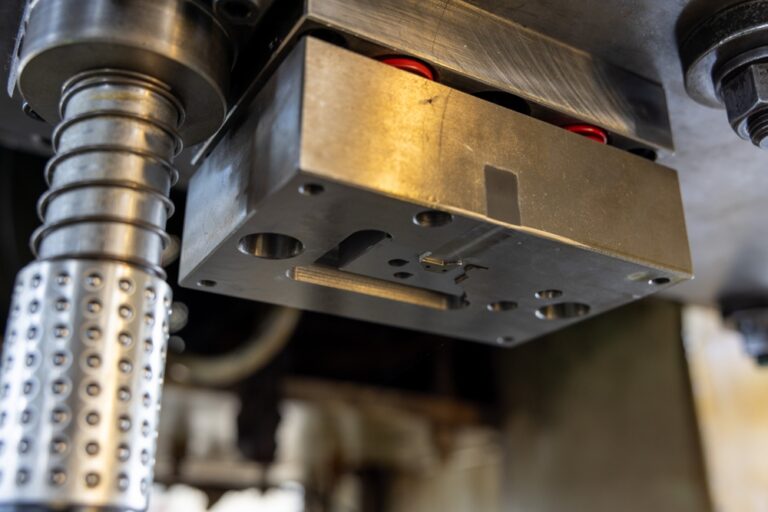
Metal stamping is a manufacturing process that uses a stamping press and custom-designed tooling called dies to cut, shape, bend, or form sheet metal into finished or semi-finished components.
The process applies tremendous force to metal positioned between precision dies. As the press closes, the tooling performs one or more operations that permanently reshape the material into the desired geometry.
Depending on the complexity of the component, metal stamping may involve:
- Blanking
- Piercing
- Forming
- Bending
- Drawing
- Coining
- Embossing
- Progressive die operations
Many manufacturers combine several of these operations into a single production cycle, significantly reducing manufacturing time while improving repeatability and lowering production costs.
Because tooling controls every movement of the material, stamped parts maintain exceptional dimensional consistency even during high-volume production runs.
How Does the Metal Stamping Process Work?
Although every project has unique requirements, the basic metal stamping process follows a series of carefully engineered steps.
Step 1: Design and Engineering
Every successful stamping project begins with engineering.
Designers create CAD models of the desired component while manufacturing engineers determine:
- Material selection
- Part thickness
- Bend radii
- Tolerances
- Production volume
- Tooling requirements
- Secondary operations
Engineers also evaluate manufacturability before tooling is built, helping reduce waste and improve production efficiency.
Step 2: Tool and Die Manufacturing
Custom tooling is manufactured specifically for the part.
The die contains precision-machined cavities that shape the metal as the press cycles.
Since tooling determines the final dimensions of every component, accuracy during die construction is critical.
Well-built dies often produce millions of parts before replacement becomes necessary with proper maintenance.
Step 3: Material Preparation
Raw material typically arrives as:
- Sheet metal
- Metal coils
- Pre-cut blanks
Depending on production requirements, automated feeding systems position the material into the stamping press.
Step 4: Stamping Operations
The press forces the metal into or through the die.
During one stroke, the tooling may perform several operations simultaneously, including:
- Cutting
- Punching holes
- Bending
- Forming
- Drawing
- Trimming
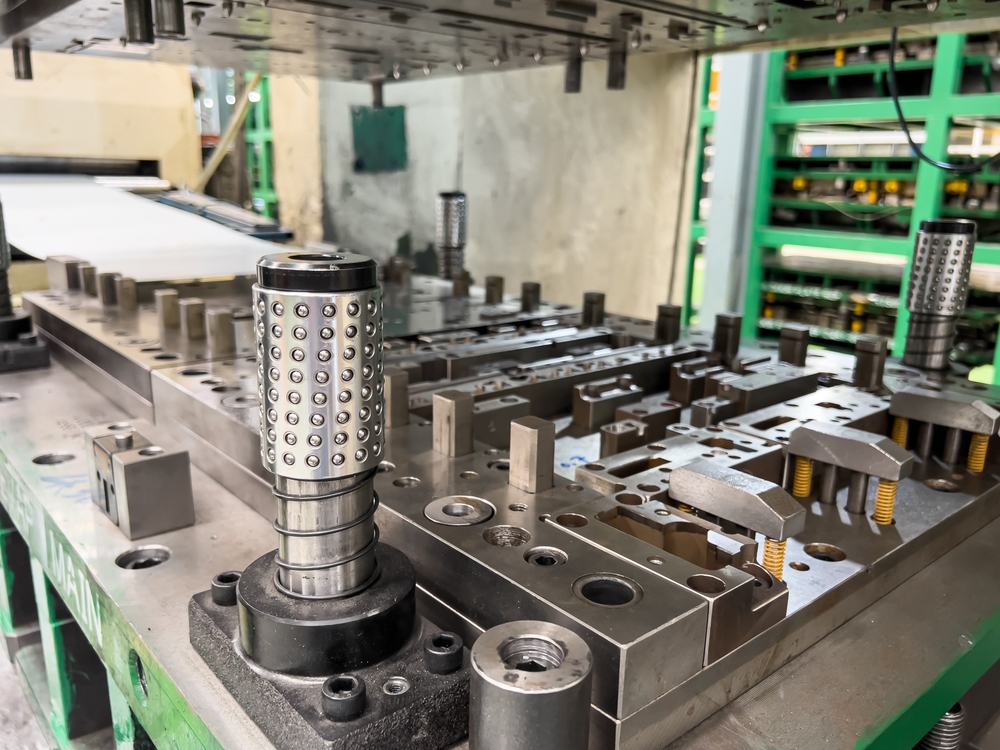
Complex progressive dies complete multiple operations at different stations before producing a finished part.
Step 5: Finishing Operations
After stamping, parts may undergo additional processes such as:
- Deburring
- Tumbling
- Surface finishing
- Welding
- Machining
- Heat treating
- Plating
- Inspection
- Assembly
These secondary operations ensure the final component meets customer specifications.
Types of Metal Stamping Processes
Metal stamping is not a single manufacturing technique. Instead, it includes several specialized forming methods that can be used independently or together.
Progressive Die Stamping
Progressive die stamping feeds metal through multiple stations within a single die.
Each station performs one operation before advancing the strip to the next position.
By the final station, the completed component is separated from the remaining strip.
This process is ideal for:
- High-volume production
- Tight tolerances
- Complex geometries
- Fast cycle times
Transfer Die Stamping
Transfer die stamping moves individual workpieces from one station to another rather than keeping them attached to a continuous strip.
This approach works well for larger or deeper components that require multiple forming stages.
Deep Draw Stamping
Deep drawing forms flat sheet metal into three-dimensional shapes with significant depth.
Examples include:
- Cylindrical housings
- Metal containers
- Appliance components
- Automotive parts
Deep drawing requires careful control of material flow to prevent tearing or wrinkling.
Four-Slide Stamping
Four-slide stamping uses four independently moving slides that approach the material from different directions.
This process is particularly effective for producing:
- Clips
- Brackets
- Springs
- Electrical contacts
- Small precision components
Fine Blanking
Fine blanking is a specialized process that produces exceptionally smooth edges with minimal secondary finishing.
It is commonly used when components require:
- Precision edges
- Tight tolerances
- Excellent flatness
- Minimal burrs
Common Metal Stamping Operations
Several individual manufacturing operations make up the broader stamping process.
Blanking
Blanking cuts the desired part shape from sheet metal.
The removed piece becomes the finished workpiece.
Piercing
Piercing creates holes or slots without removing the overall component.
Bending
Bending reshapes flat material into angled sections while maintaining material integrity.
Forming
Forming changes the geometry of the metal without significantly altering thickness.
Coining
Coining applies extremely high pressure to create detailed surface features or strengthen certain areas.
Embossing
Embossing raises or recesses designs, lettering, or patterns into the material.
Metals Commonly Used in Metal Stamping
Material selection plays a major role in manufacturing performance, durability, and cost.
Common materials include:
Steel
Steel remains the most frequently stamped material because of its strength, versatility, and affordability.
Applications include:
- Automotive parts
- Industrial equipment
- Structural components
- Appliances
Stainless Steel
Stainless steel offers excellent corrosion resistance and durability.
Industries commonly using stainless steel include:
- Medical
- Food processing
- Marine
- Aerospace
Aluminum
Aluminum provides lightweight strength while resisting corrosion.
It is widely used for:
- Electronics
- Automotive components
- Consumer products
- Aerospace assemblies
Copper
Copper delivers exceptional electrical conductivity.
Stamped copper components frequently appear in:
- Electrical connectors
- Bus bars
- Switches
- Electronic assemblies
Brass
Brass combines corrosion resistance with attractive appearance and excellent machinability.
Common applications include decorative hardware and electrical components.
Industries That Depend on Metal Stamping
Metal stamping supports nearly every major manufacturing sector.
Automotive Manufacturing
Automakers rely on stamped parts for:
- Brackets
- Chassis components
- Seat hardware
- Engine components
- Electrical systems
- Safety features
High-volume production makes metal stamping particularly valuable for automotive manufacturing.
Aerospace
Aircraft manufacturers require lightweight precision parts with exceptional consistency.
Stamped aerospace components include:
- Mounting brackets
- Clips
- Structural reinforcements
- Shielding components
Medical Devices
Medical manufacturers use precision stamping to produce:
- Surgical instruments
- Medical housings
- Clips
- Connectors
- Implant components
Strict quality standards make precision tooling essential.
Electronics
Electronic products contain hundreds of stamped components, including:
- Battery contacts
- Shields
- Connectors
- Terminals
- Heat sinks
Consumer Products
Everyday products containing stamped components include:
- Appliances
- Power tools
- Furniture
- HVAC equipment
- Lighting fixtures
- Lawn equipment
Advantages of Metal Stamping
Metal stamping remains one of the most efficient manufacturing processes available.
High Production Speed
Modern stamping presses can produce hundreds—or even thousands—of parts per hour.
Automation further increases throughput while maintaining quality.
Exceptional Consistency
Precision tooling ensures every component matches design specifications.
This consistency is critical for assembly operations and quality control.
Cost Efficiency
Although tooling requires an upfront investment, production costs decrease significantly as volume increases.
For medium- to high-volume manufacturing, metal stamping often provides the lowest cost per part.
Reduced Material Waste
Engineers optimize die layouts to maximize material utilization.
Efficient nesting reduces scrap while lowering overall manufacturing costs.
Excellent Repeatability
Because dies control every production cycle, manufacturers achieve highly repeatable results over long production runs.
Design Flexibility
Today’s stamping technology supports increasingly complex geometries that once required multiple manufacturing methods.
Metal Stamping vs. Other Manufacturing Processes
Choosing the right manufacturing process depends on production volume, complexity, material, and budget.
Metal Stamping vs. Machining
Machining removes material using cutting tools.
Metal stamping reshapes material using pressure.
Stamping generally offers:
- Faster production
- Lower cost at high volumes
- Less material waste
- Greater production efficiency
Machining remains ideal for low-volume production and highly complex features that cannot be stamped.
Metal Stamping vs. Laser Cutting
Laser cutting excels for prototypes and small production runs because tooling is unnecessary.
Metal stamping becomes more economical once production volumes increase.
Metal Stamping vs. Fabrication
Fabrication often combines cutting, bending, and welding in multiple stages.
Stamping consolidates many operations into a single automated production process.
How Precision Tooling Affects Quality
Tooling is the foundation of every successful metal stamping operation.
Well-designed dies improve:
- Part consistency
- Dimensional accuracy
- Production speed
- Surface finish
- Tool life
- Manufacturing efficiency
Regular maintenance also extends tooling lifespan while reducing downtime.
Experienced manufacturers monitor tooling wear continuously to maintain quality throughout long production runs.
Secondary Services That Add Value
Many manufacturers require more than stamping alone.
A full-service manufacturing partner often provides additional capabilities that simplify production and reduce lead times.
These services commonly include:
Wire Forming
Wire forming creates custom components from round wire stock, including springs, clips, hooks, and specialty shapes that complement stamped assemblies.
Tumbling and Finishing
After stamping, components may require tumbling and finishing to remove burrs, smooth edges, improve appearance, or prepare surfaces for coating and assembly.
Welding
Welding is another big need manufacturers have. Resistance welding, MIG welding, TIG welding, and spot welding are frequently used to join stamped components into larger assemblies.
Machining
Some parts require precision machining after stamping to create threaded holes, tight-tolerance features, or finished surfaces that cannot be achieved during the stamping process alone.
Working with a manufacturer that offers these integrated services often reduces production time, transportation costs, and quality risks associated with managing multiple vendors.
How to Choose the Right Metal Stamping Company
Not every manufacturer offers the same level of expertise.
When evaluating a metal stamping partner, consider factors such as:
- Engineering support
- Tool and die capabilities
- Quality control systems
- Production capacity
- Material expertise
- Secondary manufacturing services
- Industry certifications
- Prototype capabilities
- Experience with similar applications
A manufacturer that provides engineering assistance early in the design phase can often identify opportunities to simplify production, lower costs, and improve overall part performance.
The Future of Metal Stamping
Manufacturing technology continues to evolve.
Today’s metal stamping operations increasingly incorporate:
- Automated material handling
- Robotic part transfer
- Vision inspection systems
- In-die sensors
- Real-time production monitoring
- Predictive maintenance
- Advanced simulation software
These technologies improve productivity while helping manufacturers achieve even tighter quality standards.
Despite advances in manufacturing, precision metal stamping remains one of the fastest, most reliable, and most economical ways to produce high-quality metal components in large quantities.
Why Metal Stamping Continues to Power Modern Manufacturing
Metal stamping is far more than simply pressing metal into shape. It is a highly engineered manufacturing process that combines precision tooling, advanced equipment, material science, and decades of production expertise to create durable, repeatable components efficiently.
Whether producing millions of automotive brackets or intricate electronic connectors, metal stamping delivers the speed, consistency, and cost-effectiveness that manufacturers demand. When paired with complementary services such as wire forming, tumbling and finishing, welding, and machining, it becomes part of a complete manufacturing solution capable of supporting projects from prototype development through full-scale production.
For companies seeking dependable, high-volume production with exceptional quality, metal stamping remains one of the most valuable manufacturing processes available.
Custom Stamping has decades of experience working with metals. If you need a quote, reach out to our team by calling (864) 296-1300 or you can reach out online here.
Frequently Asked Questions About Metal Stamping
What is metal stamping?
Metal stamping is a manufacturing process that uses dies and stamping presses to cut, bend, shape, or form sheet metal into finished components. It is widely used to produce precise, repeatable parts efficiently for high-volume manufacturing.
What materials can be used in metal stamping?
Common materials include carbon steel, stainless steel, aluminum, copper, brass, and specialty alloys. The best material depends on the application’s strength, corrosion resistance, conductivity, and weight requirements.
What industries use metal stamping?
Metal stamping is used across numerous industries, including automotive, aerospace, electronics, medical device manufacturing, construction, agriculture, telecommunications, HVAC, and consumer products.
Is metal stamping suitable for high-volume production?
Yes. Metal stamping is specifically designed for medium- and high-volume manufacturing. Once tooling is created, manufacturers can produce thousands or even millions of consistent parts with excellent efficiency.
What is the difference between progressive die stamping and transfer stamping?
Progressive die stamping keeps the metal attached to a continuous strip as it moves through multiple stations. Transfer stamping separates each workpiece and moves it individually between forming stations, making it better suited for larger or more complex parts.
Does metal stamping require secondary operations?
It can. Depending on the application, stamped components may undergo tumbling and finishing, machining, welding, heat treating, plating, deburring, or assembly before they are ready for use.
How accurate is metal stamping?
Modern precision metal stamping can achieve extremely tight tolerances when paired with properly designed tooling, quality materials, and well-maintained equipment. Accuracy depends on the complexity of the part, material properties, and manufacturing requirements.
Can custom metal stamping produce complex parts?
Absolutely. With advanced tooling, progressive dies, and precision engineering, custom metal stamping can produce highly complex components featuring multiple bends, holes, embossed features, and intricate geometries in a single production cycle.