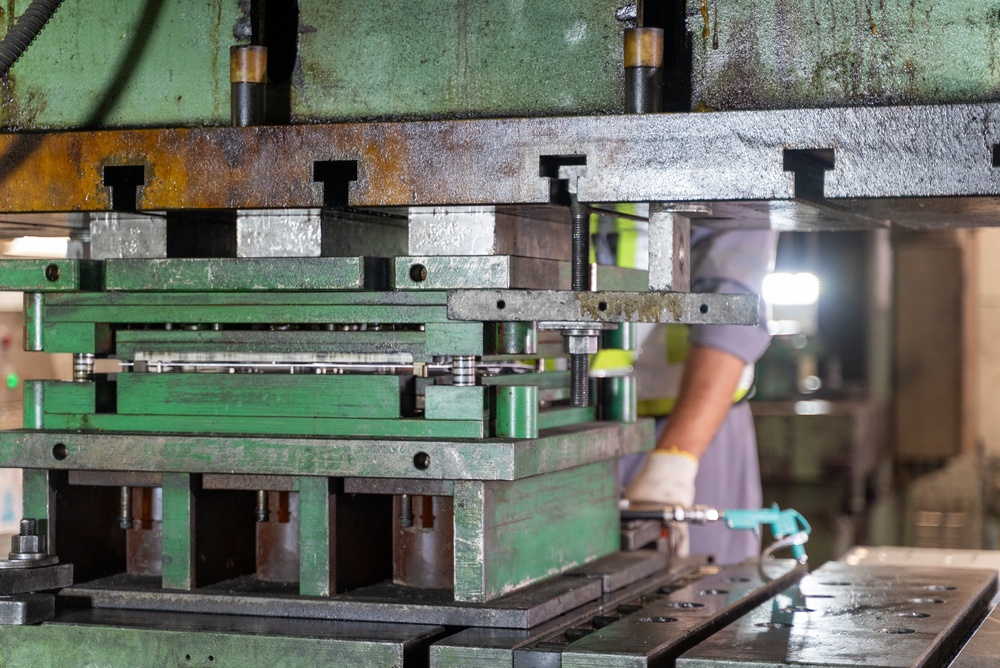
Choosing between metal stamping and CNC machining is not simply a matter of deciding which manufacturing process is better. Both can produce accurate, dependable metal components, but they achieve that result in very different ways. The right choice depends on the geometry of the part, material, tolerances, production volume, tooling requirements, lead time, and how the component will function once it is assembled.
Metal stamping is particularly effective when a project requires repeatable production of sheet metal parts at moderate to high volumes. Once the tooling and process are established, manufacturers can produce components rapidly with consistent dimensions from one part to the next.
CNC machining takes a different approach. Rather than forming a part with dies and presses, machining removes material from a workpiece using computer-controlled cutting tools. That makes it exceptionally useful for complex three-dimensional features, tight tolerances, prototypes, and production runs where dedicated stamping tooling may not make economic sense.
Understanding the practical differences between metal stamping vs. CNC machining can help engineers, product developers, and purchasing teams select a manufacturing method based on the entire production lifecycle—not just the initial price of a part.
What Is Metal Stamping?
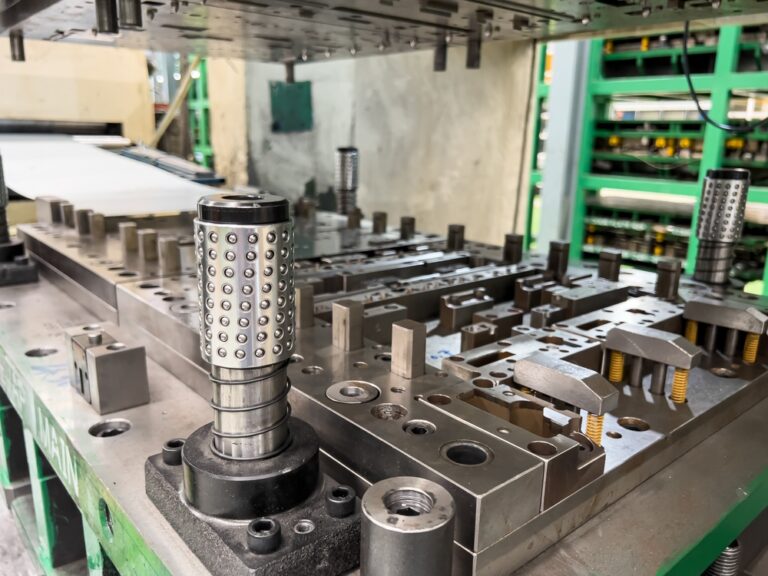
Metal stamping is a manufacturing process that converts flat sheet or coil metal into a specified shape using a stamping press and tooling. Depending on the component, the process can involve blanking, punching, bending, drawing, coining, embossing, or several operations performed in sequence.
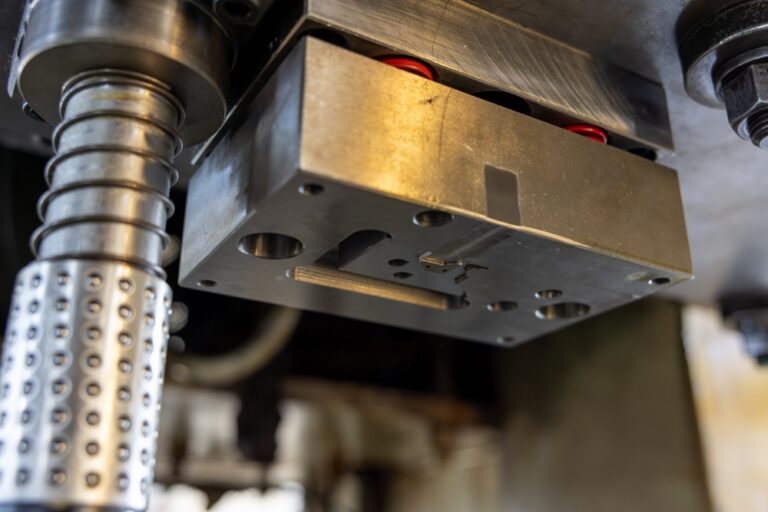
The tooling is designed around the geometry of the component. During production, the press applies controlled force to the material, causing it to be cut or formed into the required configuration. We covered metal stamping in-depth if you want to learn more: What Is Metal Stamping
Stamping can be performed as an individual operation, but higher-volume projects often use progressive dies. In progressive die stamping, material advances through a series of stations. Each station performs a specific operation until a completed component exits the tooling.
This ability to perform multiple operations efficiently is one reason metal stamping is widely used for brackets, clips, terminals, washers, electrical components, automotive parts, appliance hardware, and other repeat-production components.
Common stamping materials include:
- Carbon and stainless steel
- Aluminum
- Copper
- Brass
- Bronze
- Nickel alloys
- Other formable sheet metals and specialty alloys
Material thickness, hardness, grain direction, springback, bend radius, and required tolerances all influence how the tooling and stamping sequence should be designed.
What Is CNC Machining?
CNC machining uses computer-controlled equipment to remove material from a workpiece until the desired geometry remains. CNC stands for computer numerical control, referring to the programmed instructions that control machine movements, cutting paths, speeds, feeds, and tool changes.
Milling and turning are two of the most common CNC machining processes.
CNC mills use rotating cutting tools to remove material from a stationary or controlled workpiece. They can produce holes, slots, pockets, contours, flat surfaces, and complex three-dimensional geometries.
CNC lathes typically rotate the workpiece while cutting tools remove material. Turning is particularly well suited to cylindrical components such as shafts, bushings, pins, and threaded parts.
Modern CNC equipment can perform highly sophisticated operations with excellent dimensional control. Multi-axis machines can access a workpiece from several directions, reducing the number of setups required for complicated components.
Because the manufacturing process is driven largely by programming rather than dedicated forming dies, CNC machining is especially valuable for prototypes, lower-volume components, engineering changes, and parts with geometries that cannot readily be created from sheet metal.
Metal Stamping vs. CNC Machining: The Key Differences
The fundamental difference between metal stamping and CNC machining is how the material becomes a finished part.
Stamping primarily cuts and forms sheet or coil material using pressure and tooling. CNC machining generally starts with a solid piece of material and removes what is not needed.
That difference affects virtually every aspect of production.
Tooling and Setup
Metal stamping usually requires purpose-built tooling. Depending on the complexity of the component, that could mean relatively simple tooling or a sophisticated progressive die containing numerous operations.
This creates a higher upfront investment. Tool design, engineering, fabrication, testing, and process development must take place before full production begins.
CNC machining generally requires less dedicated tooling. Manufacturers still need appropriate fixtures, cutting tools, workholding, and CNC programming, but creating a completely new die is usually unnecessary.
For a company that needs 20 prototype parts, investing in a progressive stamping die may make little sense. If that same company eventually needs hundreds of thousands of identical sheet metal components, the economics can change dramatically.
Production Volume
Production quantity is one of the strongest factors when evaluating metal stamping vs. CNC machining.
CNC machining is often attractive at low volumes because manufacturers can begin production without making a large investment in dedicated dies. Programming and setup costs can be spread across a relatively small number of parts.
Stamping becomes increasingly competitive as production volume rises. The initial tooling cost can be distributed across thousands, hundreds of thousands, or potentially millions of components.
This creates an important distinction between tooling cost and unit cost.
A stamped component may require a larger investment before production begins while ultimately delivering a much lower cost per piece over a high-volume program. CNC machining can require less upfront investment while carrying a higher per-part cost because every component consumes machine time.
There is no universal quantity where one process automatically becomes less expensive. The crossover point depends on part complexity, material, machining cycle time, number of stamping operations, tooling cost, secondary operations, and expected lifetime volume.
Cost Considerations: Look Beyond the Initial Quote
Comparing manufacturing methods solely by their initial quotations can lead to the wrong conclusion.
Suppose CNC machining requires little upfront tooling but costs significantly more for every completed part. For a small production run, that can be perfectly reasonable. For a program expected to produce 500,000 units over several years, the accumulated machining cost may far exceed the cost of developing stamping tooling.
Stamping economics often work in the opposite direction. Tooling creates an initial capital expense, but high production speeds and efficient material handling can reduce the cost per unit considerably once production reaches scale.
A useful cost analysis should consider:
- Tooling and fixture costs
- Programming and engineering
- Material utilization
- Machine or press cycle time
- Labor requirements
- Secondary operations
- Scrap generation
- Inspection requirements
- Tool maintenance
- Expected annual volume
- Total program volume
- Part revisions
- Packaging and handling
The cheapest manufacturing method during product development may not be the least expensive method across the full production program.
Which Process Is Better for High-Volume Production?
Metal stamping generally has a significant advantage for high-volume production when the component is compatible with the process.
A properly developed stamping operation can produce parts rapidly and repeatedly. Progressive dies are especially efficient because multiple manufacturing steps can occur as the material travels through the press.
A component might be pierced at one station, trimmed at another, formed farther down the die, and cut free at the final station. Rather than moving each workpiece between separate machines, the tooling integrates these operations into a continuous production sequence.
CNC machining must typically perform cutting operations on each individual workpiece. Even with automation, pallet systems, bar feeders, and efficient toolpaths, material removal requires time.
For this reason, machining a feature for 100 parts and machining the same feature for 500,000 parts remain fundamentally different production commitments.
When a stamped part is engineered correctly and demand is sufficient, stamping can offer substantial advantages in throughput and unit economics.
Which Process Is Better for Prototypes and Low-Volume Parts?
CNC machining often has the advantage during prototyping and low-volume manufacturing.
A CAD model can be converted into CNC programming, fixtures can be prepared, and components can be manufactured without waiting for a dedicated production die to be built.
That flexibility is valuable during product development because designs frequently change.
Imagine an engineer discovers after testing 15 prototypes that a mounting hole needs to move 0.080 inch. Updating a CNC program may be relatively straightforward. Altering completed stamping tooling can be more involved and may require modifying or rebuilding portions of a die.
CNC machining therefore provides valuable design flexibility before a component reaches its final production configuration.
That does not mean stamping cannot support lower quantities. Short-run stamping, simple dies, and other tooling strategies can be viable. The economics need to be evaluated against the specific project rather than applying a fixed volume rule.
Comparing Precision and Tolerances
CNC machining is frequently chosen when extremely tight dimensional tolerances or highly controlled three-dimensional features are required.
The process can accurately control hole locations, diameters, depths, flat surfaces, profiles, and other machined features. The achievable tolerance depends on the material, equipment, tooling, geometry, setup, and inspection requirements.
Metal stamping is also capable of producing highly accurate components. Once the tooling is developed and the process is stable, stamping offers excellent repeatability across large quantities.
However, stamped parts behave differently from machined components. Forming metal introduces variables such as springback, material thickness variation, grain direction, and work hardening. Experienced tooling engineers account for these behaviors during die development.
The important question is therefore not whether CNC machining is “precise” and stamping is not. Both are precision manufacturing processes. The correct question is whether the required tolerance is appropriate for the geometry, material, production method, and function of the component.
Overly restrictive tolerances can increase manufacturing costs regardless of which process is selected.
Part Geometry Can Determine the Best Manufacturing Process
Production volume matters, but part geometry can override volume considerations.
Stamping excels with components that can be created from sheet or coil material through cutting and forming operations. Examples include:
- Brackets
- Clips
- Contacts and terminals
- Covers
- Flat or formed washers
- Mounting plates
- Retainers
- Shields
- Spring components
- Tabs and connectors
CNC machining is better suited to many components that require substantial thickness, deep pockets, complex contours, precision bores, threads, or three-dimensional features that cannot practically be stamped.
Typical machined components include:
- Bushings
- Housings
- Manifolds
- Pins
- Shafts
- Spacers
- Precision blocks
- Threaded components
A designer should avoid forcing a part into a manufacturing process simply because that process is familiar. Designing around the capabilities of the intended production method can reduce cost and simplify manufacturing.
Material Utilization and Scrap
Material efficiency is another important distinction between stamping and machining.
CNC machining is a subtractive process. A block, billet, bar, or other workpiece begins larger than the finished component, and cutting tools remove material to create the final shape. The removed material becomes chips or other scrap that may be collected and recycled.
For components requiring substantial material removal, the difference between purchased material and finished-part weight can be significant.
Stamping starts with sheet or coil stock and can often achieve efficient material utilization through careful strip layout and part nesting. Scrap still occurs around blanks, holes, carrier strips, and other areas, but tooling engineers can optimize layouts to improve yield.
Material utilization becomes increasingly important as production quantities rise, particularly when working with expensive alloys. Saving even a small amount of material per component can have a meaningful effect across a high-volume program.
Production Speed and Cycle Time
Once a stamping die is running, production can be extremely fast. Presses can cycle repeatedly while automated material feeding keeps the process moving.
Progressive stamping takes this further by integrating multiple operations within the die.
CNC cycle times depend on how much material must be removed, the number of features, required tool changes, cutting parameters, setups, and the complexity of the toolpath. Manufacturers can optimize these factors, but each part still requires a defined amount of machining.
This makes cycle-time analysis particularly important when projected demand increases.
A process that comfortably produces 500 parts per year may become a production bottleneck when demand reaches 100,000.
Surface Finish and Secondary Operations
Neither metal stamping nor CNC machining necessarily represents the final step in manufacturing.
Stamped parts can require deburring, tumbling, cleaning, plating, coating, heat treatment, welding, or assembly. Machined parts may similarly require deburring, tumbling, anodizing, plating, heat treatment, welding, grinding, or other finishing processes.
CNC machining can create controlled surface finishes directly through appropriate cutting operations, although additional finishing may still be required for cosmetic, wear, corrosion-resistance, or functional reasons.
Stamped components can exhibit burrs at cut edges, tool marks, or other characteristics associated with forming and shearing. Proper die maintenance, process control, and secondary finishing help manage these conditions.
Manufacturability should therefore be evaluated through the completed component—not merely the moment it leaves the stamping press or CNC machine.
Design Changes and Product Development
CNC machining offers considerable flexibility when designs are still evolving.
Programming can often be adjusted without creating entirely new production tooling. This makes machining useful for prototype iterations, engineering validation, bridge production, and products that undergo frequent design changes.
Stamping rewards design stability.
Once a production die has been engineered around a specific component, significant geometry changes can require tooling modifications. Some changes are manageable; others may affect several die stations or require new tooling.
Companies expecting substantial future volume may therefore use both processes during different stages of the product lifecycle.
A common strategy is:
- Machine prototypes for initial testing.
- Refine the design based on engineering results.
- Machine additional parts for validation or early production.
- Finalize the production geometry.
- Develop stamping tooling for higher-volume manufacturing.
This approach provides flexibility when flexibility is valuable and production efficiency when volume justifies it.
When Metal Stamping Is Usually the Better Choice
Metal stamping deserves serious consideration when a component is manufactured from sheet metal, the design can be produced through cutting and forming, and demand is high enough to justify dedicated tooling.
It is especially attractive when a project requires:
- Moderate to high production quantities
- Fast repeat production
- Consistent part geometry
- Efficient sheet or coil material utilization
- Multiple forming and piercing operations
- Low unit costs at production scale
- Long-term repeatability
The greatest economic benefits typically emerge when the product design is stable and demand continues over an extended production program.
When CNC Machining Is Usually the Better Choice
CNC machining becomes especially valuable when flexibility, intricate geometry, or tight dimensional control outweigh the advantages of high-speed stamped production.
It may be the better option for:
- Prototypes
- Low-volume production
- Thick or solid components
- Complex 3D geometry
- Precision bores and pockets
- Threads
- Frequent engineering revisions
- Parts unsuitable for forming from sheet metal
- Components with very demanding dimensional requirements
CNC machining can also serve as a secondary operation for components that are primarily manufactured through another process.
This is where the comparison becomes more nuanced: stamping and machining do not always compete with one another.
Sometimes the Best Solution Uses Both Stamping and Machining
Some components benefit from a hybrid manufacturing strategy.
A manufacturer might stamp the basic component because stamping efficiently creates most of its geometry. The part can then move to a CNC machining operation to create a feature that would be difficult, inefficient, or impractical to incorporate into the die.
This approach can make sense when most of a high-volume component is stamp-friendly but a critical surface, hole, pocket, or other feature requires machining.
The same principle applies to additional manufacturing capabilities. A stamped or machined component may subsequently require welding, wire forming, tumbling, deburring, or finishing before it is ready for assembly.
Working with a manufacturer capable of supporting multiple processes can simplify these projects. It allows manufacturing engineers to choose the process that makes sense for each feature instead of trying to make one method accomplish everything.
How Material Choice Affects the Decision
Material selection can significantly influence whether stamping or CNC machining is more practical.
For stamping, engineers need to consider formability. A material that bends or draws predictably may be an excellent candidate, while a hard or brittle material can create tooling and forming challenges.
Important stamping considerations include:
- Tensile and yield strength
- Ductility
- Material thickness
- Hardness
- Grain direction
- Springback
- Work-hardening behavior
Machining presents a different set of material considerations. Material hardness, thermal properties, abrasiveness, chip formation, cutting speed, and tool wear can all affect machining efficiency.
Some alloys machine easily. Others require slower cutting parameters or specialized tooling, increasing cycle times and costs.
Material should consequently be evaluated as part of the manufacturing strategy rather than selected independently and handed to the manufacturer after the design is complete.
Designing Parts for Metal Stamping
Good design for manufacturability can substantially improve stamping performance and economics.
Engineers should pay close attention to hole sizes, hole-to-edge distances, bend radii, material thickness, tolerances, formed features, and spacing between features.
Extremely tight bends or features located too close to an edge can create production challenges. Specifying unnecessarily tight tolerances can also make tooling more complex without improving how the finished assembly functions.
Early collaboration between the product designer and stamping manufacturer can identify these issues before tooling is built.
Small design adjustments at the CAD stage can sometimes prevent costly tooling changes later.
Designing Parts for CNC Machining
CNC machining has its own design-for-manufacturability principles.
Deep narrow pockets, sharp internal corners, difficult tool access, extremely thin walls, and unnecessary surface-finish requirements can increase machining time and cost.
For example, rotating cutting tools naturally create radii in internal corners. Specifying a perfectly sharp internal corner may require an additional process even when the feature serves no functional purpose.
Likewise, unnecessarily deep cavities may require long cutting tools, slower machining parameters, and additional passes.
A machinable design is not necessarily an economical design. Providing engineers with the functional requirements of the component allows them to identify areas where geometry or tolerances can be adjusted without compromising performance.
Metal Stamping vs. CNC Machining Cost at Different Production Volumes
There is no reliable universal cost-per-part comparison because each component presents a different manufacturing challenge.
The general cost relationship, however, is useful during planning.
At low volumes, CNC machining may offer better economics because dedicated stamping tooling can represent a large portion of the total project cost.
At higher volumes, stamping often gains an advantage because tooling expenses are distributed across more units while press production can achieve short cycle times.
Consider a simplified example. If stamping tooling costs $25,000 but saves $2 per part compared with machining, the tooling investment would theoretically be recovered after 12,500 parts, before accounting for other cost differences.
Real manufacturing comparisons are more complicated. Material yield, secondary operations, maintenance, inspection, labor, packaging, and expected program life all need to be considered.
Still, the example illustrates why buyers should evaluate total program economics instead of comparing only the first purchase order.
How to Choose Between Metal Stamping and CNC Machining
A productive process-selection discussion begins with the component’s actual requirements.
Before requesting a manufacturing quote, define:
- Part geometry and dimensions
- Material and material thickness
- Critical tolerances
- Surface-finish requirements
- Prototype quantity
- Initial production quantity
- Estimated annual usage
- Expected lifetime volume
- Secondary operations
- Assembly requirements
- Anticipated design revisions
- Target production schedule
Volume should be considered alongside design maturity. A company expecting substantial future demand may still choose CNC machining during development because the design has not yet stabilized.
Conversely, a proven product with predictable demand may justify investing in production stamping tooling much earlier.
The best process is the one that delivers the required component reliably at an appropriate total cost over the expected life of the program.
Why Manufacturing Capabilities Beyond the Primary Process Matter
The finished component may require far more than stamping or machining.
A metal part can need welding before assembly. Sharp edges or burrs may need to be removed through tumbling and finishing. Another product may combine stamped components with formed wire.
Coordinating these processes among several unrelated vendors can add transportation, scheduling, quality-control, and supply-chain complexity.
Custom Stamping & Manufacturing supports projects through five core manufacturing capabilities: metal stamping, machining, wire forming, welding, and tumbling and finishing. Having complementary capabilities available can be particularly useful for projects in which the most efficient manufacturing route combines multiple operations.
Rather than asking whether every component should be stamped or every component should be machined, the better objective is to develop a production process around the requirements of the finished part.
Metal Stamping vs. CNC Machining: Making the Right Decision
Metal stamping and CNC machining solve different manufacturing problems.
Metal stamping is often the stronger choice for repeatable sheet metal components produced at scale. Its dedicated tooling requires an upfront investment, but rapid press cycles and efficient production can provide compelling economics as volumes increase.
CNC machining provides greater flexibility for prototypes, low-volume orders, complex three-dimensional parts, precision features, and products that are still undergoing engineering changes.
For some projects, neither process should be considered in isolation. Machining can support prototype development before a product transitions to stamping, or it can add precision features to an otherwise stamped component.
That is why the most effective process selection starts with the part itself. Geometry, tolerances, material behavior, production quantities, secondary operations, design maturity, and lifetime demand should collectively determine how the component is manufactured.
Looking for metal stamping company? We’re here to help you with all your stamping needs. Check out our full service offering. You can reach us at anytime by calling (864) 296-1300
Frequently Asked Questions About Metal Stamping vs. CNC Machining
Is metal stamping cheaper than CNC machining?
Metal stamping can be less expensive per part at higher production volumes because presses can manufacture components quickly after the tooling has been developed. However, stamping generally requires a larger upfront tooling investment. CNC machining may be more economical for prototypes and smaller production runs because dedicated stamping dies are not required. The appropriate comparison is total program cost rather than unit price alone.
Is CNC machining more accurate than metal stamping?
CNC machining is particularly effective for extremely tight tolerances and complex three-dimensional features, but precision metal stamping can also provide excellent accuracy and repeatability. The achievable tolerance with either process depends on the material, geometry, equipment, tooling, and feature being measured.
What production volume makes metal stamping worthwhile?
There is no fixed minimum quantity. The economic crossover depends on tooling cost, component complexity, material, machining time, stamping cycle time, secondary operations, and lifetime production requirements. A manufacturer can compare both approaches using projected annual and total program volumes.
Can CNC machining be used for mass production?
Yes. CNC machining is widely used for production manufacturing, including higher-volume applications, particularly when the geometry cannot be stamped. Automation, multi-axis equipment, bar feeders, pallet systems, and optimized toolpaths can increase productivity. For suitable sheet metal components at very high quantities, however, stamping may offer faster cycle times and lower unit costs.
Can metal stamping produce complex parts?
Yes. Progressive dies and other precision tooling can produce surprisingly complex sheet metal components using multiple cutting and forming operations. The primary limitation is whether the geometry can practically be created from the selected sheet or coil material.
What materials can be used for metal stamping?
Common stamping materials include carbon steel, stainless steel, aluminum, copper, brass, bronze, and various specialty alloys. The appropriate material depends on the component’s strength, conductivity, corrosion resistance, formability, thickness, and application requirements.
What materials can be CNC machined?
CNC machining can process a broad range of metals, including aluminum, steel, stainless steel, brass, bronze, copper, and many specialty alloys. Machinability varies by material, which can influence cutting speeds, tool wear, cycle times, and ultimately part cost.
Is metal stamping faster than CNC machining?
For suitable components in high-volume production, metal stamping is generally much faster on a per-part basis. A stamping press can repeatedly produce parts at high cycle rates, while CNC machines must complete programmed cutting operations for each workpiece. During prototyping, however, CNC machining can have a shorter overall lead time because a production stamping die does not need to be designed and built first.
Should I use CNC machining for prototypes before metal stamping?
It can be an effective strategy when a component’s geometry can be adequately represented through machining. CNC prototypes allow engineers to test fit, dimensions, and functionality before committing to production tooling. However, a machined prototype will not always duplicate the material properties or forming characteristics of a stamped part, so final validation may still require stamped samples.
Can a part require both metal stamping and CNC machining?
Yes. A component can be stamped to efficiently create its primary geometry and then CNC machined to add critical features. Hybrid manufacturing can be particularly useful when a high-volume part is well suited to stamping overall but contains one or more features that are difficult to produce within the stamping die.
How do I know whether my part should be stamped or machined?
Start with the component’s geometry, material, thickness, tolerances, production quantity, expected lifetime volume, secondary operations, and likelihood of future design changes. Flat and formed sheet metal parts produced in substantial quantities are often strong candidates for stamping. Solid, thick, highly three-dimensional, or low-volume precision components are frequently better suited to CNC machining. A manufacturer with experience in both processes can evaluate the design and recommend the most practical production route.