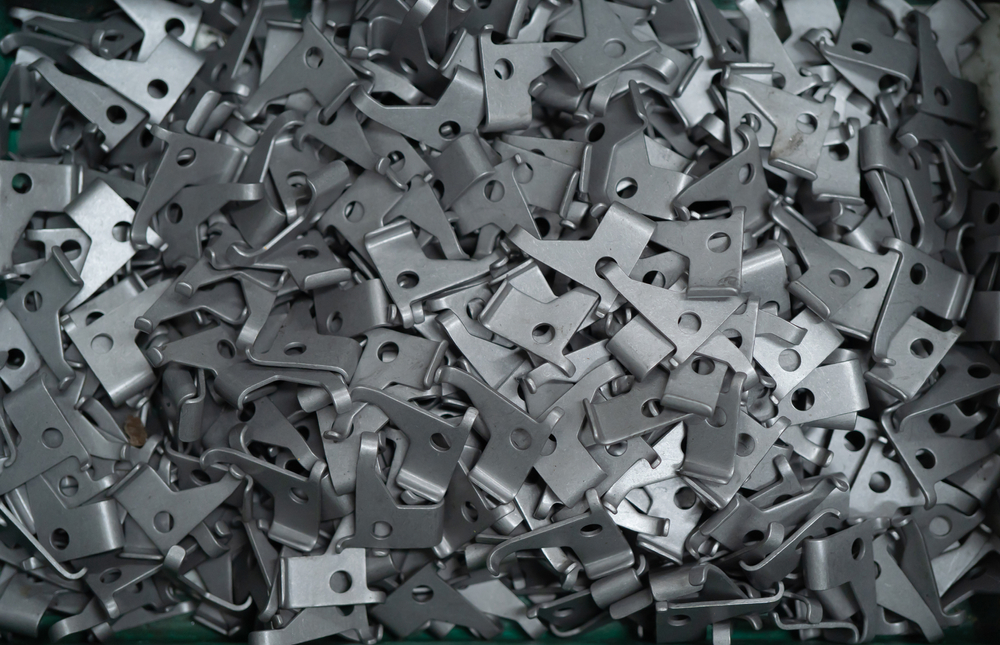
Steel metal stamping is one of the most widely used manufacturing methods for producing strong, repeatable components at scale. From automotive brackets and appliance hardware to industrial clips, electrical enclosures, structural parts, and precision assemblies, stamped steel components appear in products across nearly every major manufacturing sector.
The appeal is straightforward. Steel offers strength, stiffness, durability, broad material availability, and an enormous range of grades. Stamping adds speed and repeatability by using presses and precision tooling to transform sheet or coil stock into finished shapes.
Yet successful steel stamping is not simply a matter of placing sheet metal in a press. Material grade, hardness, thickness, grain direction, die clearance, forming pressure, bend geometry, lubrication, tooling design, and production volume all affect how a part performs during manufacturing and in service.
For companies evaluating steel metal stamping for a new component or looking to improve an existing production process, understanding those variables is essential.
What Is Steel Metal Stamping?
Steel metal stamping is a manufacturing process that uses specialized dies and stamping presses to cut, bend, shape, draw, or form flat steel into a specific component.
The raw material may be supplied as sheet, strip, or coil. During production, the steel moves through tooling that performs one or more operations until the required geometry is achieved.
Common operations include:
- Blanking
- Piercing
- Punching
- Bending
- Flanging
- Coining
- Embossing
- Drawing
- Trimming
- Forming
- Progressive die stamping
Some parts require only one or two operations. Others move through several carefully sequenced die stations before they are complete.
The process is particularly effective when large quantities of identical parts must be produced with consistent dimensions and relatively short cycle times.
Why Steel Is So Widely Used in Metal Stamping
Steel is not a single uniform material. It is a broad family of alloys with dramatically different mechanical, chemical, and forming characteristics.
That variety is one of its greatest advantages.
A manufacturer may choose a low-carbon steel when formability and economical production matter most, stainless steel when corrosion resistance is critical, or a high-strength alloy when the finished component must withstand greater loads.
This flexibility makes steel suitable for an unusually wide range of stamped products.
High Strength
Steel generally offers greater strength than many common sheet-metal alternatives.
That can be valuable for load-bearing brackets, structural components, mounting hardware, fasteners, supports, automotive parts, and industrial assemblies.
Higher-strength grades can sometimes allow engineers to achieve performance targets using thinner material, although increased strength may also make forming more difficult.
Excellent Stiffness
Strength and stiffness are not the same thing.
Stiffness describes a material’s resistance to elastic deformation under load. Steel’s high modulus of elasticity gives it an advantage in applications where a component must resist bending or deflection.
This characteristic can be particularly important in brackets, frames, supports, housings, and structural stampings.
Broad Grade Availability
Steel is available in many compositions, coatings, thicknesses, and strength levels.
That allows designers to balance variables such as:
- Formability
- Strength
- Hardness
- Corrosion resistance
- Surface condition
- Weldability
- Cost
- Wear resistance
- Final finish
The correct steel grade depends on both the finished component and the manufacturing process required to produce it.
Cost Efficiency
For many high-volume applications, steel provides an attractive balance between material cost and mechanical performance.
When paired with progressive tooling or other automated stamping methods, steel components can often be produced at competitive unit costs.
Material cost alone, however, should not determine the decision. A cheaper grade that creates excessive tooling wear, cracking, secondary operations, or quality problems may ultimately cost more.
Recyclability
Steel scrap generated during stamping can generally enter established recycling streams.
Efficient strip layouts and nesting strategies can further reduce material waste by maximizing the number of components produced from each coil or sheet.
At high production volumes, even modest improvements in material utilization can have a meaningful impact on total manufacturing cost.
Common Types of Steel Used for Metal Stamping
Selecting the right steel grade is one of the most important decisions in any stamping program.
Different grades respond differently to punching, bending, drawing, welding, machining, and finishing.
Low-Carbon Steel
Low-carbon steel, sometimes referred to as mild steel, is commonly used in metal stamping because it combines good formability with relatively low material cost.
Its lower carbon content generally makes it easier to bend, draw, weld, and form than harder high-carbon steels.
Typical applications can include:
- Brackets
- Clips
- Housings
- Covers
- Appliance components
- General industrial hardware
- Electrical components
Low-carbon steel is often a practical option when the application does not require extreme strength, hardness, or corrosion resistance.
High-Strength Low-Alloy Steel
High-strength low-alloy steel, commonly abbreviated HSLA, is engineered to provide greater strength than conventional carbon steel while maintaining useful manufacturability.
HSLA grades are frequently used when weight reduction and structural performance are both priorities.
Automotive and transportation applications commonly use these steels for components that need to carry significant loads without becoming excessively heavy.
Higher strength does, however, affect the stamping process. Increased forming forces, greater springback, and tighter forming limits may need to be addressed in the tool design.
Stainless Steel
Stainless steel contains chromium and other alloying elements that provide strong corrosion resistance.
It is widely used for applications exposed to moisture, chemicals, food-processing environments, medical environments, and demanding outdoor conditions.
Common stamped stainless steel products include:
- Clips
- Brackets
- Covers
- Electrical hardware
- Food-processing components
- Medical device components
- Industrial equipment parts
Stainless steel tends to have higher strength and greater work-hardening characteristics than mild steel. That can make tooling design, press tonnage, lubrication, and die maintenance especially important.
High-Carbon Steel
High-carbon steels generally provide greater hardness, strength, and wear resistance than low-carbon grades.
They may be used for components that need spring characteristics, abrasion resistance, or higher mechanical strength.
However, increasing carbon content typically reduces formability.
Sharp bends, aggressive draws, and complex forming operations may therefore require careful material selection, heat treatment, or modified tooling strategies.
Galvanized Steel
Galvanized steel is coated with zinc to improve corrosion resistance.
It is commonly used for outdoor products, automotive components, appliance parts, HVAC equipment, electrical enclosures, and building-related applications.
When galvanized steel is stamped, tooling must account for the coated surface. Excessive abrasion can damage the coating or cause material buildup inside the die.
The coating can also influence welding and finishing requirements.
What Happens During the Steel Stamping Process?
A production stamping operation begins with engineering, not with the press.
The more complex or higher-volume the part, the more important the pre-production planning becomes.
Design and Manufacturability Review
The component drawing is evaluated to determine whether the geometry can be produced reliably through stamping.
Important factors include:
- Steel grade
- Material thickness
- Bend radii
- Hole locations
- Edge distances
- Forming depth
- Tolerances
- Production quantities
- Surface requirements
- Secondary operations
Manufacturability review often identifies opportunities to simplify the component before tooling is built.
A slight change in bend radius, hole position, tolerance, or flange length can sometimes improve forming performance or reduce tooling complexity without changing the function of the part.
Tool and Die Design
The die determines how the raw steel will be transformed.
Simple components may use individual blanking or forming dies. Higher-volume or more complex parts may use compound, transfer, or progressive tooling.
Tool designers must consider the specific properties of the steel being stamped.
Harder and stronger materials generally require:
- Greater press force
- More robust tooling
- Careful die clearances
- Controlled lubrication
- Greater attention to tool wear
- More consideration of springback
The same component geometry can require a different tooling strategy depending on the material grade.
Material Feeding
Steel may enter the stamping operation as individual sheets, blanks, strip, or continuous coil.
Coil-fed operations are common in high-volume stamping because the material can be continuously fed through the die with relatively little manual handling.
The coil may pass through equipment that uncoils, straightens, and feeds the strip into the press at precise increments.
Accurate feed progression is critical in progressive die stamping because each operation must align correctly with the previous station.
Cutting and Forming
Once the steel is positioned inside the die, the press applies force.
The operation may cut material away, deform it into a new shape, or perform both actions simultaneously.
A progressive component might begin as flat strip and gradually receive holes, slots, bends, flanges, embossed features, and trimmed edges before the final part is separated.
These steps happen quickly, but the tooling has been engineered to control how the steel flows and deforms at every stage.
Secondary Processing
Not every component leaves the press ready for final use.
Depending on the application, additional processes may include:
- Tumbling
- Deburring
- Welding
- Machining
- Surface finishing
- Cleaning
- Heat treatment
- Plating
- Assembly
- Inspection
For complex assemblies, combining stamping with secondary manufacturing capabilities can simplify production and reduce the need to coordinate multiple suppliers.
Progressive Die Steel Stamping
Progressive die stamping is one of the most efficient methods for manufacturing high-volume steel components.
A strip of material moves through a series of stations within one tool. Each station performs another operation.
For example, one die might:
- Pierce pilot holes.
- Punch functional openings.
- Trim the outside profile.
- Form a flange.
- Bend another section.
- Coin a feature.
- Cut off the completed component.
Multiple stations operate during every press cycle.
Once the strip has progressed through the entire die, a completed component can be produced with each stroke.
This method can provide several advantages:
- High production rates
- Consistent geometry
- Reduced manual handling
- Lower labor per part
- Repeatable process control
- Ability to combine multiple operations
The tooling investment is typically greater than that required for basic standalone operations, so progressive stamping tends to make the most economic sense for repeat production.
Deep Draw Stamping of Steel
Some steel components require more than simple bending.
Deep drawing transforms flat sheet into a hollow or recessed shape by drawing the material into a die cavity.
Examples may include:
- Cups
- Housings
- Containers
- Cylindrical parts
- Enclosures
- Shells
Deep drawing places substantial demands on material ductility and process control.
If material flow is poorly controlled, defects such as wrinkling, tearing, thinning, or dimensional inconsistency can occur.
Blank-holder pressure, lubrication, draw ratio, die radius, steel grade, and material thickness all influence the result.
For complex deep-drawn components, several forming stages may be necessary rather than attempting to create the full depth in a single press stroke.
Steel Stamping Challenges That Must Be Engineered Around
Steel is highly suitable for stamping, but different grades present different production challenges.
Ignoring those characteristics can lead to cracked parts, excessive tool wear, inconsistent dimensions, and higher scrap rates.
Springback
After steel is bent or formed, it tends to recover slightly toward its original geometry when press force is removed.
This springback becomes more significant with many higher-strength steels.
Tooling may need to compensate through overbending, restrike operations, specialized forming geometry, or other methods.
Consistent material properties are also important. Variations in yield strength or thickness can change the amount of springback between material lots.
Tool Wear
Steel repeatedly contacting punches and dies generates substantial mechanical stress.
High-strength or abrasive grades can accelerate wear.
As tooling wears, several problems may appear:
- Increased burr height
- Dimensional drift
- Poor cut quality
- Inconsistent holes
- Surface defects
- Higher press loads
Preventive maintenance is therefore a central part of high-volume stamping.
Replacing or sharpening tooling at controlled intervals is usually more efficient than waiting for defective parts to reveal that a tool has exceeded its useful condition.
Burr Formation
Blanking and piercing naturally create a sheared edge.
When punch-to-die clearance is incorrect or tooling becomes worn, burrs can become excessive.
Depending on the application, a burr may interfere with:
- Assembly
- Electrical contact
- Sealing
- Safety
- Cosmetic quality
- Subsequent welding or finishing
Tumbling and other deburring processes may be used when edge condition needs to be improved after stamping.
Cracking
Cracking occurs when local strain exceeds what the material can tolerate.
It may appear around sharp bends, highly stretched areas, embossed features, or deep-drawn sections.
Potential solutions include:
- Increasing bend radius
- Changing steel grade
- Modifying material thickness
- Adjusting forming sequence
- Altering tool geometry
- Improving lubrication
- Adding intermediate forming stages
Problems that appear to be tooling failures sometimes originate with material selection or component design.
Designing Steel Parts for Stamping
A well-designed stamped component considers the limitations and strengths of the process from the beginning.
Parts designed without manufacturing input often include features that are technically possible but unnecessarily difficult or expensive to produce.
Use Appropriate Bend Radii
Very sharp bends concentrate strain and increase the risk of cracking.
Minimum practical bend radius depends on the steel grade, hardness, thickness, bend orientation, and finished-part requirements.
Low-carbon steels may tolerate relatively aggressive bends. High-strength or hardened steels generally require more conservative geometry.
Maintain Proper Distance Between Holes and Bends
Holes positioned too close to bends can stretch, distort, or become oval during forming.
Adequate spacing allows the surrounding material to deform without pulling the hole out of tolerance.
The correct distance depends on material thickness and geometry, but the principle is simple: functional holes should not be placed in highly strained regions unless the tooling and sequence have been designed accordingly.
Avoid Unnecessary Tight Tolerances
Precision has a cost.
Some dimensions legitimately require close tolerance because they control mating, alignment, sealing, safety, or function.
Others do not.
Applying unnecessarily restrictive tolerances to every feature can increase:
- Tooling expense
- Die maintenance
- Inspection requirements
- Scrap rates
- Process complexity
- Production cost
A more efficient design differentiates between critical and noncritical dimensions.
Consider Material Direction
Choosing the right metal for your stamping project can be a challenge. Steel sheet is produced through rolling processes that create directional characteristics in the material.
For certain alloys and forming conditions, bend orientation relative to the rolling direction can influence cracking and dimensional behavior.
Part orientation within the strip may therefore be selected not only for material utilization but also for forming performance.
Design for Material Utilization
Steel cost can represent a significant portion of the finished component cost.
The layout of parts within the strip determines how much material becomes usable product versus stamping scrap.
Engineers may adjust part orientation, carrier design, pitch, or minor geometry to improve nesting.
These savings become increasingly valuable as annual production volume rises.
Steel Metal Stamping vs. Aluminum Metal Stamping
Steel and aluminum are both widely used in metal stamping, but their properties make them suitable for different priorities.
Steel generally provides:
- Greater stiffness
- High strength
- Excellent wear resistance in certain grades
- Broad material availability
- Competitive material cost
Aluminum generally provides:
- Lower weight
- Natural corrosion resistance
- High thermal conductivity
- High electrical conductivity
- Lower density
Steel is often preferred when structural rigidity, strength, durability, or cost are primary concerns.
Aluminum may be selected when weight reduction or conductivity matters more.
The final choice should be based on the actual application rather than on a broad assumption that one material is superior.
Steel Stamping vs. CNC Machining
CNC machining and steel stamping approach manufacturing from opposite directions.
Machining removes material from a workpiece. Stamping reshapes and cuts sheet or coil using dedicated tooling.
Machining can be advantageous for:
- Prototypes
- Small production runs
- Thick components
- Complex three-dimensional geometries
- Features requiring machining-specific precision
Stamping is often more economical when:
- Production volume is high
- The part can be made from sheet material
- Repeatability is critical
- Cycle time matters
- Multiple operations can be incorporated into tooling
Many components benefit from both processes.
The basic geometry may be stamped efficiently, while select features are machined afterward to achieve threads, bores, precise surfaces, or complex details that would be impractical to stamp.
Steel Stamping vs. Fabrication
Traditional sheet-metal fabrication may use laser cutting, punching, press braking, welding, and manual handling to produce a component.
This can be highly effective for prototypes, large components, and lower-volume production.
Stamping becomes more attractive as production volumes increase.
Dedicated tooling reduces repeated setup and manual processing, allowing the same features to be created rapidly and consistently.
A fabricated bracket may be ideal for an initial production run of several dozen parts. If demand eventually grows into tens of thousands or hundreds of thousands of units, progressive stamping may significantly reduce unit cost.
Industries That Rely on Steel Metal Stamping
Steel stamping serves an unusually wide range of markets because the material can be adapted to so many mechanical and environmental requirements.
Automotive and Transportation
The automotive industry uses enormous quantities of stamped steel.
Applications range from small clips and brackets to structural components and large body panels.
Examples can include:
- Mounting brackets
- Reinforcements
- Retainers
- Clips
- Shields
- Seating components
- Suspension-related hardware
- Structural supports
High-strength steel grades are increasingly used where manufacturers need to improve structural performance while controlling vehicle weight.
Appliances
Home and commercial appliances contain numerous stamped components.
Washers, dryers, refrigerators, ovens, dishwashers, and HVAC equipment may contain stamped brackets, supports, panels, retainers, covers, and mounting hardware.
High production quantities make stamping particularly economical in this market.
Electrical and Electronics
Steel can provide the structural rigidity and shielding required for many electrical components.
Stamped applications may include:
- Enclosures
- Mounting plates
- Covers
- Clips
- Brackets
- Shields
- Frames
Surface coatings may be added when corrosion resistance or electrical characteristics require additional control.
Industrial Equipment
Machines and industrial assemblies rely on stamped steel components for countless mechanical functions.
Examples include:
- Retaining components
- Mounts
- Guards
- Plates
- Supports
- Clips
- Housings
- Linkages
The combination of strength and production efficiency makes steel particularly attractive for repeat industrial programs.
Construction and Building Products
Stamped steel can also be found in building systems, hardware, fasteners, brackets, HVAC equipment, electrical products, and construction-related assemblies.
Galvanized or coated steels may be selected when corrosion protection is necessary.
Consumer Products
Household products, tools, furniture, hardware, outdoor equipment, and other consumer goods frequently incorporate stamped steel parts.
These applications often balance durability, appearance, unit cost, and production volume.
Secondary Operations for Steel Stampings
Stamping can create most or all of a component’s geometry, but many parts require additional processing.
Tumbling and Finishing
Tumbling can help remove burrs, soften sharp edges, clean surfaces, or prepare stamped parts for later finishing.
This is especially useful when parts have numerous cut edges or when edge quality affects handling and assembly.
Finishing requirements may also include coating, plating, painting, polishing, or other surface treatments performed according to the component’s final environment and appearance requirements.
Welding
Stamped steel components are commonly welded into larger assemblies.
Depending on part geometry and volume, welding operations may include resistance welding, spot welding, MIG welding, TIG welding, or other processes.
Material chemistry, coating, thickness, and joint design all influence weld quality.
Considering welding requirements while designing the stamping can make the entire manufacturing sequence more efficient.
Machining
Machining may be used after stamping when the part requires:
- Threads
- Precision holes
- Counterbores
- Tapped features
- Tight-tolerance surfaces
- Complex three-dimensional details
Using stamping for the basic geometry and machining only where necessary can provide an efficient balance between production speed and precision.
Wire Forming and Assembly Integration
Some finished products combine stamped steel parts with wire forms, machined components, welded subassemblies, or other fabricated pieces.
Working with a manufacturer capable of coordinating metal stamping, wire forming, tumbling and finishing, welding, and machining can streamline these programs.
Instead of moving components among several suppliers, multiple processes can be coordinated within a more integrated manufacturing workflow.
What Determines the Cost of Steel Metal Stamping?
The cost of a stamped steel component depends on far more than material price.
Important variables include:
- Steel grade
- Material thickness
- Part size
- Component complexity
- Production quantity
- Tooling complexity
- Number of die stations
- Press tonnage
- Material utilization
- Required tolerances
- Tool maintenance
- Secondary processing
- Quality requirements
- Packaging
Production volume often has a particularly large effect on the economics.
Dedicated progressive tooling may require substantial initial investment, but the same tool can produce large numbers of components with relatively low labor per part.
For high-volume programs, the per-unit savings can outweigh the upfront tooling cost.
Tooling Cost vs. Part Cost
When comparing stamping quotes, tooling and piece price should be evaluated together.
A lower-cost tool may require additional handling, secondary operations, or slower cycle times.
A more sophisticated progressive die may cost more initially but eliminate operations from every part produced during the life of the program.
For example, one tooling strategy might require the part to be stamped, moved to another machine, manually formed, and then returned for additional processing.
Another tool might complete those same operations automatically inside the press.
If production volume is large enough, the second option can produce a lower total program cost even though its tooling price is higher.
How to Reduce the Cost of a Steel Stamping Project
Cost reduction is most effective when addressed before tooling is finalized.
Several design and manufacturing decisions can have a major effect.
Improve Material Utilization
Reorienting the component inside the strip can sometimes increase the number of parts produced from a coil.
Material savings repeat across every production run.
For large annual volumes, this can become one of the most valuable opportunities for cost reduction.
Simplify the Geometry
Complexity that does not improve component performance should be questioned.
Unnecessary forms, tight radii, decorative features, or difficult-to-access areas can add die stations and tooling expense.
Simplification can often improve both reliability and cost.
Reduce Secondary Operations
Every time a component leaves the stamping process for another operation, additional handling and production time are introduced.
Where practical, features can sometimes be incorporated into the stamping die instead.
Pierced holes, formed tabs, coined details, and certain attachment features may be produced directly during stamping rather than added later.
Review Tolerances
A tolerance that is tighter than the application requires may force the manufacturer to use additional processes or inspection.
Designers should determine which dimensions are genuinely functional and where standard stamping tolerances are sufficient.
Match Tooling to Production Volume
The most economical tooling strategy depends on how many parts will be produced.
Simple tooling may be appropriate for modest volumes. Progressive or automated tooling becomes increasingly attractive as production rises.
Tooling decisions should be based on anticipated lifetime demand rather than the first purchase order alone.
Quality Control in Steel Stamping
Consistent stamping requires control over material, tooling, press setup, and inspection.
Important part characteristics may include:
- Hole diameter
- Hole location
- Bend angle
- Formed height
- Flatness
- Overall dimensions
- Burr condition
- Surface finish
- Material thickness
- Critical mating features
For high-volume programs, in-process monitoring may help detect dimensional drift before a large quantity of nonconforming parts is produced.
Tool maintenance also plays a direct role in quality.
As cutting edges wear, burrs increase. As forming surfaces deteriorate, dimensions can shift. Scheduled inspection and maintenance help keep the process stable over long production runs.
When Does Custom Steel Metal Stamping Make Sense?
Custom steel stamping is particularly well suited to repeat-production components that can be manufactured from sheet or coil.
It becomes especially attractive when:
- Annual quantities are moderate to high
- Part geometry is stable
- Repeatability is important
- Several operations can be automated
- Manual fabrication would be expensive
- Production speed matters
- Material utilization can be optimized
- Long-term demand justifies tooling
For very small quantities or early prototypes, alternative methods such as laser cutting, press braking, or machining may provide greater flexibility.
As volume increases, dedicated stamping tooling can significantly improve the production economics.
What to Look for in a Steel Metal Stamping Manufacturer
A capable stamping supplier should do more than operate presses.
They should understand material behavior, tooling, production planning, quality control, and downstream manufacturing.
Before requesting a quote, provide as much useful information as possible, including:
- Part drawings
- CAD files
- Required steel grade
- Material thickness
- Estimated annual quantity
- Expected program duration
- Critical tolerances
- Surface requirements
- Welding requirements
- Machining requirements
- Finishing requirements
- Inspection expectations
It is often beneficial to involve the manufacturer before the design is completely finalized.
A stamping engineer may identify opportunities to simplify a bend, change a feature location, reduce scrap, eliminate a secondary process, or improve tooling reliability.
Those adjustments are far easier to make before production dies have been built.
Steel Metal Stamping for High-Volume Manufacturing
Steel metal stamping continues to be one of the most effective ways to produce durable, repeatable components at scale.
Its value comes from combining two major advantages: the mechanical performance of steel and the efficiency of press-based manufacturing.
The best results depend on making the right decisions early.
Steel grade, thickness, geometry, bend requirements, tooling strategy, production volume, surface condition, and downstream operations should all be evaluated as parts of the same manufacturing system.
When those factors are aligned, stamping can deliver high production rates, reliable quality, strong material utilization, and competitive long-term part costs.
For projects requiring more than a single manufacturing step, Custom Stamping & Manufacturing provides capabilities across metal stamping, wire forming, tumbling and finishing, welding, and machining. Combining these processes can simplify sourcing and create a more efficient path from raw material to completed component or assembly.
Ready to get started on your steel metal stamping project? Get a free estimate today, give our team a call at (864) 296-1300.
Frequently Asked Questions About Steel Metal Stamping
What is steel metal stamping?
Steel metal stamping is a manufacturing process that uses stamping presses and dies to cut, bend, form, draw, or shape steel sheet or coil into finished components. It is commonly used for repeat production where consistency, strength, and efficient cycle times are important.
What types of steel can be stamped?
Many types of steel can be stamped, including low-carbon steel, stainless steel, galvanized steel, high-strength low-alloy steel, and certain high-carbon steels. The correct grade depends on strength requirements, formability, corrosion resistance, welding needs, and part geometry.
What is the best steel for metal stamping?
There is no single best steel for every stamping project. Low-carbon steel is commonly chosen for economical forming, stainless steel for corrosion resistance, HSLA steel for higher structural strength, and high-carbon steel for components requiring hardness or spring properties.
Is steel easy to stamp?
Many steel grades are highly suitable for stamping, but formability varies significantly. Low-carbon steels are generally easier to bend and draw than high-strength, stainless, or high-carbon grades. Tooling and press requirements must be matched to the specific steel.
Can stainless steel be metal stamped?
Yes. Stainless steel is frequently stamped into brackets, clips, housings, electrical components, food-processing parts, medical components, and industrial hardware. Its higher strength and work-hardening characteristics require careful tooling design and process control.
What is progressive die steel stamping?
Progressive die stamping moves steel strip through several stations inside a single die. Each station performs another operation, such as piercing, trimming, bending, or forming. A finished part can be produced with each press cycle after the strip has advanced through all stations.
What thickness of steel can be stamped?
Stampable thickness depends on the steel grade, part geometry, tooling, press tonnage, and operation being performed. Metal stamping can accommodate a broad range of sheet thicknesses, but thicker material requires greater cutting and forming force.
Does steel stamping create burrs?
Cutting operations such as blanking and piercing can create burrs along sheared edges. Proper die clearance and sharp tooling help control burr formation. Tumbling, deburring, or other finishing processes may be used when smoother edges are required.
Why does steel spring back after bending?
Springback occurs because part of the deformation during bending is elastic. When forming pressure is removed, the steel recovers slightly toward its original shape. Higher-strength steels generally exhibit more springback, so tooling may need to compensate for the expected movement.
Is steel stamping cheaper than CNC machining?
For high-volume sheet-metal components, stamping can often produce a lower unit cost once tooling has been established. CNC machining may be more appropriate for low quantities, prototypes, thicker parts, or geometries that cannot be efficiently formed from sheet.
Can stamped steel parts be welded?
Yes. Stamped steel components are frequently welded into larger assemblies. Weldability depends on the steel grade, coating, thickness, joint design, and welding process.
Can stamped steel parts be machined afterward?
Yes. Secondary machining is common when stamped components need threads, precision bores, counterbores, tapped holes, or features that would be difficult to produce inside the stamping die.
How accurate is steel metal stamping?
Steel stamping can achieve highly repeatable dimensions when tooling, material, and press conditions are properly controlled. Actual tolerances depend on part size, material thickness, geometry, operation type, tooling design, and the specific feature being measured.
What industries use steel stamping?
Steel stamped components are widely used in automotive, transportation, appliances, electrical equipment, industrial machinery, construction products, consumer goods, HVAC equipment, furniture, and many other manufacturing sectors.
What information is needed for a steel stamping quote?
A complete request for quote should ideally include drawings or CAD files, steel grade, material thickness, tolerances, estimated annual quantities, program duration, finishing requirements, secondary operations, inspection expectations, and any critical functional features.