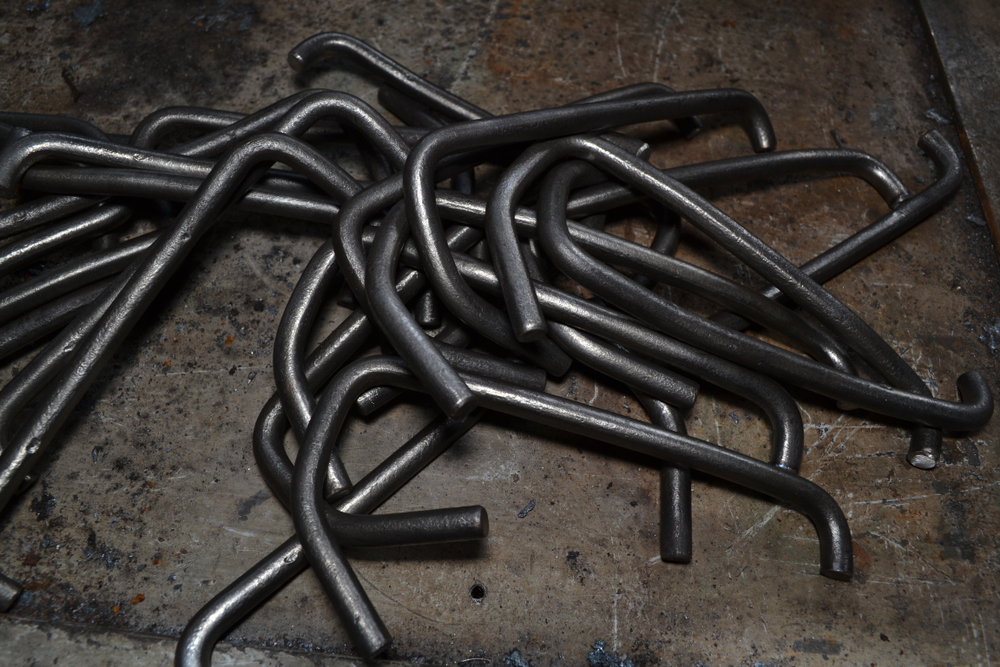
Wire forming is a manufacturing process that transforms metal wire into specific shapes, profiles, and functional components. Depending on the part, manufacturers may bend, cut, coil, straighten, flatten, thread, weld, or otherwise manipulate wire to create everything from simple clips and hooks to complex precision components.
Although the finished parts can look relatively simple, producing them consistently is a precision manufacturing challenge. Wire diameter, material properties, bend radius, springback, tooling, dimensional tolerances, production volume, and the intended application can all influence how a component should be made.
Modern wire forming processes are used across automotive, aerospace, construction, electronics, medical equipment, appliances, industrial machinery, consumer products, and many other markets. For manufacturers that need high-volume production, custom wire forming can also be integrated with metal stamping, machining, welding, tumbling, and finishing operations to produce complete components and assemblies.
Understanding how wire forming works makes it easier to choose the right material, manufacturing process, and production partner for a project.
What Is Wire Forming?
Wire forming is the process of mechanically shaping metal wire into a predetermined configuration without removing most of the original material. Straight wire, coiled wire, or wire supplied on spools can be fed into forming equipment and manipulated through a controlled series of bends, cuts, curves, coils, and other operations.
The result is known as a wire form.
Wire forms can range from straightforward two-dimensional shapes to intricate three-dimensional parts containing multiple bends at different angles. Common examples include:
- Clips
- Hooks
- Pins
- Rings
- Brackets
- Handles
- Links
- Retaining components
- Fastening devices
- Spring-related components
- Wire supports
- Electrical contacts
- Mounting components
- Custom industrial wire parts
The exact configuration depends on what the component needs to accomplish. Some wire forms hold other components in position. Others provide tension, create a mechanical connection, guide movement, support a load, conduct electricity, or become part of a larger welded or mechanically assembled product.
This versatility is one reason custom wire forming appears in so many different manufacturing environments.
How Does the Wire Forming Process Work?
The basic concept behind wire forming sounds straightforward: take wire and bend it into the required shape. Production manufacturing is considerably more precise.
The process begins with the part requirements. Engineers and manufacturers evaluate the component’s dimensions, geometry, wire diameter, material, tolerances, mechanical requirements, surface condition, production volume, and end-use environment.
A typical production sequence may involve several stages.
Wire Selection
The first step is selecting an appropriate wire material and diameter.
Material choice affects strength, corrosion resistance, ductility, electrical properties, appearance, fatigue performance, and how easily the wire can be formed. The wire must tolerate the forming operations without cracking or experiencing unacceptable deformation.
Diameter is equally important. A seemingly small change in wire diameter can affect forming forces, tooling requirements, bend characteristics, stiffness, and the performance of the finished component.
Straightening and Feeding
Wire frequently arrives at the manufacturing facility in coils or on spools. Before forming, it may need to be straightened as it enters the equipment.
A feeding mechanism advances a controlled amount of material into the forming area. Accurate feeding is particularly important during automated production because the position of each bend depends on precisely controlling how much wire moves through the machine.
Bending and Shaping
The wire is then manipulated into its specified geometry.
Tooling applies force at predetermined locations to create bends, curves, loops, offsets, or other features. More complex parts can require numerous forming operations performed sequentially.
Computer-controlled equipment can coordinate wire feed, rotation, tooling movement, and bending angles to create sophisticated three-dimensional geometries.
Cutting
Once the necessary length has been formed, the component is separated from the remaining wire.
Cutting may occur before, during, or after the primary forming operations depending on the production method and component design.
The cut itself matters. End geometry, burrs, deformation, and surface condition can affect subsequent assembly or the performance of the final component.
Secondary Operations
A formed wire component may require additional manufacturing before it is complete.
Depending on the design, secondary operations can include welding, machining, threading, flattening, piercing, grinding, deburring, tumbling, heat treatment, coating, plating, or other finishing processes.
Combining wire forming with secondary manufacturing capabilities can reduce the number of vendors involved in producing a finished component.
Common Wire Forming Processes
There is no single wire forming method that works for every component. Manufacturers choose equipment and tooling according to the geometry, material, tolerance requirements, wire size, production quantity, and economics of the project.
CNC Wire Forming
Computer numerical control, or CNC, wire forming uses programmable machinery to control the movement and manipulation of wire.
The equipment feeds wire from a coil and coordinates tooling movements according to programmed instructions. Depending on the machine, the wire itself, forming head, tooling, or a combination of these elements can move to create the required geometry.
CNC wire forming is especially valuable for complicated parts because it provides precise control over multiple bends and planes.
Benefits can include:
- Repeatable production
- Complex two-dimensional and three-dimensional geometries
- Efficient high-volume manufacturing
- Fast production cycles
- Reduced manual handling
- Consistent bend locations and angles
- Flexibility when producing different component designs
CNC technology also makes it possible to manufacture wire forms that would be difficult or inefficient to produce through manual bending.
Four-Slide and Multi-Slide Forming
Four-slide and multi-slide machines use multiple tooling slides that approach the workpiece from different directions.
Instead of relying exclusively on traditional vertical press movement, the equipment can perform forming operations from several sides. This capability makes multi-slide manufacturing useful for parts containing multiple bends or features that need to be created in sequence.
The process can be highly efficient for repeat production because several operations can occur within the same manufacturing cycle.
Depending on the component, multi-slide equipment may perform operations such as:
- Bending
- Cutting
- Piercing
- Flattening
- Stamping
- Coining
- Forming
Multi-slide technology is particularly useful when a manufacturer needs to produce large quantities of repeatable components while minimizing separate production steps.
Roll Forming
Roll forming gradually shapes material as it passes through a sequence of rollers.
While roll forming is often associated with sheet or strip metal, rolling techniques can also be incorporated into certain wire processing applications. The material is progressively shaped instead of receiving the entire deformation in one operation.
The suitability of roll forming depends heavily on the required profile and production requirements.
Coiling
Coiling wraps wire around a tool, mandrel, or controlled forming point to create circular or helical configurations.
Springs are perhaps the most recognizable example, but coiled wire geometry can appear in many other industrial components.
Coiling operations must carefully control variables such as wire diameter, coil diameter, pitch, material properties, and the number of turns.
Bending
Bending is fundamental to nearly every wire forming operation.
The manufacturer applies controlled force to deform the wire around a tooling point or specified radius. Depending on the design, a wire form might contain one bend or a long sequence of bends positioned in multiple planes.
The relationship between material characteristics and bend geometry is critical. Attempting to force certain metals around excessively tight radii can create cracking, excessive stress, distortion, or dimensional problems.
Flattening and Swaging
Some wire forms require specific sections to have a different cross-sectional geometry.
Flattening compresses an area of round wire to create a flatter surface. This can provide space for holes, attachment points, contact surfaces, identification features, or other design elements.
Swaging can alter the diameter or profile of a portion of the component through controlled deformation.
These processes allow engineers to incorporate additional functionality without necessarily manufacturing the entire component from a more expensive starting shape.
Welding
Some custom wire products cannot be created entirely through bending.
Welding can join the ends of a wire form, connect multiple wire components, or attach formed wire to stamped, machined, or fabricated parts.
Examples include frames, racks, guards, baskets, supports, brackets, and larger assemblies.
Having wire forming and welding capabilities within the same manufacturing operation can simplify production when the finished product requires both processes.
What Materials Are Used for Wire Forming?
Material selection has a direct effect on manufacturability and component performance. Engineers must consider not only whether a material can perform in the final application but also whether it can withstand the required forming operations.
Several metals are commonly used for custom wire forms.
Carbon Steel Wire
Carbon steel offers a useful combination of strength, availability, formability, and cost, making it suitable for a broad range of industrial applications.
Different carbon contents and grades provide different mechanical characteristics. Lower-carbon steels generally offer greater ductility and easier forming, while higher-carbon materials can provide increased strength and hardness.
Carbon steel wire forms may be used in:
- Automotive components
- Construction products
- Industrial equipment
- Appliances
- Fasteners
- Retaining components
- General-purpose hardware
Where corrosion is a concern, carbon steel components can receive protective coatings or finishes.
Stainless Steel Wire
Stainless steel is widely used when corrosion resistance, durability, cleanliness, or appearance is important.
Its properties make stainless steel wire forming suitable for demanding environments where moisture, chemicals, weather exposure, or frequent cleaning could damage ordinary carbon steel.
Common applications can be found in food processing equipment, medical products, outdoor hardware, appliances, transportation equipment, and industrial machinery.
Different stainless steel grades behave differently during forming, so material selection should account for both the service environment and manufacturing requirements.
Aluminum Wire
Aluminum offers low density and good corrosion resistance, making it useful when reducing component weight is a priority.
It can also provide good electrical and thermal conductivity. These characteristics make aluminum relevant to electrical, transportation, aerospace, consumer, and specialty industrial applications.
Because aluminum alloys differ significantly in strength and ductility, the appropriate alloy and temper need to be matched to the wire form’s geometry and performance requirements.
Copper Wire
Copper is best known for its excellent electrical and thermal conductivity.
Wire forming with copper is therefore common in electrical and electronic applications, although copper components are also used in industrial equipment and specialty products.
Copper’s relatively high ductility makes many forming operations possible, but the final design still needs to account for the mechanical characteristics of the particular copper alloy.
Brass Wire
Brass combines useful corrosion resistance, formability, electrical conductivity, and visual appeal.
It may be selected for electrical components, hardware, decorative products, fixtures, specialty fasteners, and applications where both appearance and functionality matter.
As with other metals, different brass alloys provide different combinations of strength and formability.
Other Wire Materials
Specialized applications may require materials beyond common carbon steel, stainless steel, aluminum, copper, and brass.
Depending on performance requirements, manufacturers may work with alloy steels, nickel alloys, specialty stainless grades, or other engineered metals.
Material selection should ultimately be based on what the component must do rather than simply which material is easiest to form.
Why Material Properties Matter in Wire Forming
A wire form that looks simple on a drawing can behave quite differently during manufacturing depending on its material.
Several properties deserve particular attention.
Ductility
Ductility describes a material’s ability to deform without fracturing. Wire that must undergo severe bends or complex shaping generally requires sufficient ductility to tolerate those operations.
Tensile Strength
Tensile strength indicates how much pulling stress a material can withstand before failure.
Higher strength can be beneficial in service, but stronger materials may also require greater forming forces and different tooling strategies.
Hardness
Hardness influences wear resistance and how easily the material can be deformed. Harder wire can increase tooling loads and may be more difficult to form into tight geometries.
Corrosion Resistance
Components exposed to moisture, chemicals, outdoor environments, or repeated washing may require inherently corrosion-resistant materials or an appropriate protective finish.
Electrical Conductivity
For electrical contacts, connectors, grounding components, and similar products, conductivity can become one of the primary material-selection criteria.
Springback
Metal does not necessarily remain exactly where tooling bends it.
After forming pressure is released, elastic recovery can cause the material to move slightly toward its original position. This phenomenon is known as springback.
Experienced wire forming manufacturers compensate for springback through tooling design, bend programming, material knowledge, and process control. Without that compensation, bend angles and final dimensions may fall outside the specified tolerance.
Wire Forming Design Considerations
Successful wire form manufacturing often begins long before production equipment starts running. Part design can significantly affect manufacturability, consistency, tooling costs, and production speed.
Wire Diameter
Wire diameter influences virtually every aspect of the component.
Thicker wire generally requires greater forming force and can limit how tightly certain bends can be produced. Diameter also affects component strength, weight, stiffness, and material usage.
The specified tolerance on wire diameter can also influence the dimensional consistency of the finished part.
Bend Radius
Extremely tight bends create higher material strain.
A bend radius that works well with one material may cause cracking or distortion in another. Engineers should therefore evaluate bend radius alongside wire diameter, alloy, temper, and mechanical properties.
Designing realistic bend radii can improve production reliability and extend tooling life.
Bend Location and Geometry
The sequence and proximity of bends can determine whether a part is straightforward or challenging to manufacture.
Closely spaced bends may create tooling-access problems. Three-dimensional geometries can require careful sequencing so one completed feature does not interfere with formation of the next.
Design for manufacturability reviews can identify these issues before production tooling is finalized.
Dimensional Tolerances
Not every dimension needs the same tolerance.
Overly restrictive tolerances can increase tooling complexity, inspection requirements, production costs, and scrap without improving how the component functions.
Critical dimensions should receive appropriate tolerances based on fit and function. Noncritical dimensions can often use broader tolerances that make production more economical.
End Condition
Designers sometimes focus heavily on bends while overlooking the ends of the wire.
The component may require square-cut ends, rounded edges, chamfers, threads, flattened sections, loops, welded joints, or another end treatment.
How the wire terminates should therefore be specified as part of the original design.
Production Volume
A prototype quantity of 20 pieces and a production order of 2 million pieces present very different manufacturing challenges.
For low quantities, minimizing tooling investment may be the priority. For high-volume wire forming, automated equipment and dedicated tooling can substantially reduce the cost per component.
Manufacturers should consider anticipated annual volume when determining the most economical production method.
Tolerances and Quality Control in Wire Forming
Consistency becomes increasingly important as production volume increases.
A wire form may need to fit into an assembly, align with another component, maintain a specified gap, support a defined load, or provide repeatable spring characteristics. Small dimensional variations can therefore create problems farther down the production line.
Quality control may evaluate characteristics such as:
- Overall dimensions
- Wire diameter
- Bend angles
- Bend locations
- Radius dimensions
- Part orientation
- Surface condition
- End geometry
- Weld quality
- Coating or finish
- Functional fit
Inspection methods vary according to component complexity and tolerance requirements.
Simple components may be checked using gauges or conventional measurement equipment. Complex wire forms can require fixtures, optical measurement systems, coordinate measuring equipment, or application-specific testing.
Quality planning should focus particularly closely on the dimensions and characteristics that influence final product performance.
Secondary Operations for Custom Wire Forms
Wire forming does not always end when the final bend is completed.
Secondary operations can turn a basic wire form into a finished component ready for assembly.
Tumbling and Finishing
Cutting and forming operations can leave burrs, sharp edges, or surface irregularities.
Tumbling and other finishing processes can improve surface condition, remove burrs, smooth edges, and prepare components for subsequent coating or assembly.
Finishing requirements depend heavily on the application. A hidden industrial retaining clip has different cosmetic requirements from a visible consumer-product component.
Machining
Certain wire forms require features that cannot be efficiently created through bending alone.
Machining may be used to produce threads, flats, precision surfaces, holes, or other detailed features.
Combining machining with wire forming can be particularly useful when a component needs both an economical formed geometry and tightly controlled functional features.
Metal Stamping
Wire forms are frequently used alongside stamped metal components.
A manufacturing project might require a formed wire component that attaches to a stamped bracket, housing, clip, or other sheet-metal part. Coordinating metal stamping and wire forming can help simplify sourcing and assembly.
Welding and Assembly
Wire forms can be welded to one another or combined with stamped and machined components to create more complex assemblies.
This is common with frames, guards, supports, racks, brackets, and structural products.
A manufacturer capable of wire forming, metal stamping, machining, welding, tumbling, and finishing can potentially manage several stages of a project under one production relationship rather than requiring the customer to coordinate multiple specialized suppliers.
Industries That Rely on Wire Forming
Wire forms are found throughout modern manufacturing because the process can produce lightweight, durable, repeatable components in a wide variety of geometries.
Automotive and Transportation
Vehicles contain numerous formed-wire components, many of which passengers never see.
Applications can include:
- Retaining clips
- Seat components
- Linkages
- Fasteners
- Brackets
- Supports
- Latches
- Exhaust-related hardware
- Interior mechanisms
- Electrical components
Automotive production frequently requires high repeatability and large production quantities, making automated wire forming particularly valuable.
Aerospace
Aerospace components must often satisfy demanding requirements for weight, strength, reliability, and material performance.
Formed wire components can be used for retaining, fastening, supporting, securing, and routing functions throughout aerospace assemblies.
Material traceability, dimensional control, and process consistency become especially important in applications with strict quality requirements.
Electrical and Electronics
Wire forms are a natural fit for electrical applications because many conductive metals can also be mechanically formed.
Examples include electrical contacts, terminals, grounding components, connectors, clips, leads, and other conductive hardware.
Copper and copper alloys are especially useful where conductivity is a primary concern, while other materials may be selected when mechanical strength or corrosion resistance carries greater importance.
Medical Equipment
Medical devices and healthcare equipment can contain small, precisely formed wire components.
Depending on the product, manufacturers may require corrosion-resistant materials, smooth surfaces, tight dimensional control, and highly repeatable production.
Stainless steel is frequently relevant to these applications because of its corrosion resistance and durability.
Appliances
Household and commercial appliances contain many wire components used for holding, supporting, fastening, guiding, and structural functions.
Examples can include racks, clips, brackets, handles, retainers, guards, and internal mechanical components.
For appliance manufacturers producing large quantities of identical products, repeatability and cost-efficient production are essential.
Construction and Building Products
Construction products use wire forms for fastening, supporting, securing, hanging, retaining, and reinforcement applications.
Wire components may be incorporated into hardware, building systems, fixtures, equipment, and prefabricated assemblies.
Material selection is particularly important for exterior applications where corrosion and weather exposure are concerns.
Industrial Equipment and Machinery
Industrial machinery relies on an enormous variety of specialized hardware.
Custom wire forms can serve as retaining devices, guards, guides, handles, clips, pins, supports, links, and attachment components. Because machinery designs vary significantly, these applications frequently require components manufactured to customer-specific drawings.
Consumer Products
Many familiar consumer products contain wire forms even when the components are not immediately noticeable.
Furniture, sporting goods, lawn and garden products, storage systems, household products, toys, tools, and recreational equipment can all incorporate custom wire components.
Appearance can become more important in these applications, particularly when the wire form remains visible in the finished product.
Advantages of Custom Wire Forming
Custom wire forming offers several manufacturing advantages when the process is properly matched to the component.
Efficient Material Usage
Forming changes the geometry of existing wire rather than machining an entire component from a larger block of metal. Material waste can therefore be relatively low.
High Production Speeds
Automated wire forming equipment can manufacture large quantities of components quickly once tooling and programming have been established.
Repeatability
Modern forming equipment can repeatedly create bends and features in controlled locations, making the process well suited to production environments that require consistent components.
Complex Geometry
CNC and multi-axis forming technology makes it possible to create sophisticated three-dimensional wire forms that would be difficult to manufacture manually.
Scalable Manufacturing
Wire forming can support both relatively straightforward components and high-volume industrial production. The ideal equipment and tooling strategy can be selected according to anticipated production quantities.
Integration With Other Manufacturing Processes
Wire forms can be machined, stamped, welded, tumbled, finished, coated, or assembled with other components. This makes the process particularly versatile for manufacturers that need more than a standalone bent-wire part.
Wire Forming vs. Metal Stamping
Wire forming and metal stamping are both metalworking processes, but they begin with different raw materials and are typically suited to different component geometries.
Wire forming starts primarily with wire and manipulates it into the desired shape through bending, coiling, cutting, and related operations.
Metal stamping typically begins with sheet or strip metal. A stamping press and tooling cut or deform the material to create the required component.
A wire form is often appropriate when the part’s functionality can be achieved through a relatively narrow, continuous metal profile. Stamping becomes more appropriate when a component requires broader surfaces, deep-drawn features, holes, tabs, flanges, or other sheet-metal geometry.
The two processes are also complementary. Some assemblies incorporate both stamped components and custom wire forms, which are then welded, mechanically fastened, or otherwise joined.
Wire Forming vs. Machining
Machining creates geometry primarily by removing material. Wire forming creates geometry primarily by deforming material.
For a part that can be manufactured from wire, forming can use significantly less raw material than machining the same general geometry from solid stock. Automated forming can also provide fast cycle times for high-volume production.
Machining has its own advantages. It can produce complex surfaces, holes, threads, pockets, and tightly controlled dimensional features that may be impossible to create through wire forming alone.
The processes are therefore not necessarily competing alternatives. A manufacturer can form the primary component and machine only the features that require machining, potentially achieving a more efficient overall production process.
How to Choose a Wire Forming Manufacturer
Choosing a wire forming company involves more than determining whether a supplier owns a bending machine.
The manufacturer should understand how material behavior, tooling, equipment, tolerances, secondary operations, and production quantities interact.
Before moving a project into production, consider discussing:
- Wire material and grade
- Wire diameter and tolerance
- Required part geometry
- Critical dimensions
- Bend radii
- Surface requirements
- Annual production quantities
- Prototype requirements
- Inspection requirements
- Required secondary operations
- Packaging requirements
- Assembly considerations
Manufacturing capabilities beyond wire forming can also influence the decision.
If a project requires metal stamping, machining, welding, tumbling, or finishing in addition to wire forming, consolidating those processes with a capable manufacturing partner can reduce supplier coordination and simplify production.
Design for Manufacturability Can Improve Wire Forming Projects
One of the most productive times to involve a wire forming manufacturer is before a component design becomes completely fixed.
A design may be technically possible but unnecessarily expensive to manufacture. A minor adjustment to bend radius, tolerance, material, wire diameter, or feature location can sometimes simplify tooling and improve production consistency without changing the component’s function.
This is the core principle behind design for manufacturability, or DFM.
An effective DFM review can examine whether:
- Bend radii are practical for the selected material
- Tolerances match actual functional requirements
- Tooling can access every feature
- Bend sequences are practical
- Material properties fit the application
- Secondary operations can be reduced
- The component can be produced consistently at the required volume
The goal is not simply to make the part easier to manufacture. It is to find an efficient way to produce a component that still meets its engineering and performance requirements.
Custom Wire Forming for Production Manufacturing
Wire forming can produce deceptively simple parts, but successful production depends on controlling a substantial number of variables.
Material properties influence how the wire bends. Geometry determines tooling and equipment requirements. Springback affects dimensional accuracy. Production quantities influence automation and tooling decisions. Finishing and secondary operations determine whether the formed component is actually ready for its final application.
That is why experienced manufacturing support matters, particularly for custom components or high-volume programs.
Custom Stamping works with manufacturers that need production capabilities including wire forming, metal stamping, tumbling and finishing, welding, and machining. Bringing complementary manufacturing processes together can make it easier to move a component from raw material through forming and secondary operations while maintaining consistent production requirements.
Give us a call today – you can reach by calling 864-296-1300.
Whether the project involves a straightforward wire clip or a more complicated formed component incorporated into a larger assembly, the right manufacturing process begins with understanding the part’s material, geometry, tolerances, function, and expected production volume.
Frequently Asked Questions About Wire Forming
What is wire forming?
Wire forming is a manufacturing process used to bend, shape, cut, coil, and manipulate metal wire into a specified configuration. The resulting components are known as wire forms and can include clips, hooks, rings, pins, brackets, supports, retainers, and complex three-dimensional parts.
How does wire forming work?
Wire is typically fed into forming equipment, straightened when necessary, and manipulated with specialized tooling. The equipment creates controlled bends, curves, loops, coils, or other features according to the component design. Automated CNC wire forming machines can coordinate multiple movements to produce complex parts with repeatable dimensions.
What materials can be used for wire forming?
Common wire forming materials include carbon steel, stainless steel, aluminum, copper, and brass. Specialty alloys can also be used when an application requires specific mechanical, thermal, electrical, or corrosion-resistant properties.
What products are made through wire forming?
Wire forming is used to manufacture clips, hooks, pins, retainers, brackets, rings, handles, supports, links, electrical contacts, fastening components, frames, guards, and many other custom parts.
What industries use custom wire forms?
Custom wire forming is used throughout the automotive, aerospace, electrical, electronics, medical, appliance, construction, industrial equipment, transportation, and consumer-product industries.
What is CNC wire forming?
CNC wire forming uses computer-controlled machinery to feed and manipulate wire according to programmed instructions. CNC equipment can precisely coordinate bending and rotational movements, making it suitable for repeatable production of complex two-dimensional and three-dimensional wire forms.
What is the difference between wire forming and metal stamping?
Wire forming generally starts with metal wire and creates a component through bending, coiling, cutting, and shaping. Metal stamping generally starts with sheet or strip metal and uses dies and presses to cut and form the material. Some manufactured assemblies use both stamped metal parts and wire forms.
Can wire forms be welded?
Yes. Welding can connect multiple wire forms, close a wire loop, or attach a formed-wire component to another metal part. Welding is commonly used for wire frames, guards, racks, brackets, supports, and other assemblies.
Can wire forming produce three-dimensional parts?
Yes. Modern CNC wire forming equipment can produce complex three-dimensional components with multiple bends occurring in different planes. The achievable geometry depends on the equipment, tooling, material, wire diameter, tolerances, and design of the component.
How accurate is wire forming?
Wire forming can provide highly repeatable production, but achievable tolerances depend on factors such as material, wire diameter, component geometry, bend radius, tooling, equipment, and the number of forming operations. Critical tolerances should be reviewed with the manufacturer during the design and quoting process.
What is springback in wire forming?
Springback is the slight elastic movement that occurs after forming pressure is removed from metal. Instead of remaining at exactly the angle produced by the tooling, the wire can partially move toward its original position. Manufacturers compensate for predictable springback through tooling design, machine programming, process development, and material-specific adjustments.
What information is needed for a custom wire forming quote?
A manufacturer will typically need a part drawing or CAD file along with information about the material, wire diameter, dimensions, tolerances, finish, required secondary operations, anticipated order quantity, and annual production volume. Providing details about the component’s application can also help identify potential manufacturing or material issues.
Is wire forming suitable for high-volume manufacturing?
Yes. Automated CNC and multi-slide wire forming processes can be highly effective for high-volume manufacturing. Once the production process, tooling, and machine setup have been established, large quantities of repeatable components can be produced efficiently.
Can wire forming be combined with machining and metal stamping?
Yes. A custom wire form can undergo machining or be incorporated into an assembly containing stamped components. Wire forming can also be combined with welding, tumbling, deburring, and other finishing operations. Using complementary manufacturing processes can reduce the need to move components between multiple suppliers.
How do I choose the right material for a custom wire form?
Material selection should account for the component’s required strength, ductility, corrosion resistance, electrical or thermal conductivity, operating environment, appearance, forming characteristics, and cost. The geometry matters as well. A material that performs well in the finished application must still have sufficient formability for the required bends and features.
What makes a good wire form design?
A well-designed wire form balances function with manufacturability. Appropriate bend radii, realistic tolerances, suitable material selection, accessible feature locations, practical end conditions, and consideration of the forming sequence can improve consistency and reduce unnecessary manufacturing costs. Involving the manufacturer during the design stage can help identify opportunities to simplify production before tooling is finalized.